One way to compare Japan’s more structured society with the U.S. and Europe is to look at the standardized Japanese resume form, called rirekisho (ree- REK-sho, “employment history form”). When you want to apply for a job in Japan, be it for a truck driver or sushi chef or computer programmer, you drop by a stationery store, pick up one of these standardized forms and fill it out by hand. Virtually everything that’s important about you is recorded on the form: name, address, past school and career history, what special certificates or qualifications you’ve got, and so on. There’s also a place to affix a photo so potential employers can see what you look like, always in the same place on every form. Some information isn’t recorded, of course, like blood type, since employers might have biases about people of a certain blood type. The form is very different from the open-ended way job resumes are prepared in the U.S., usually a single sheet that succinctly describes a person’s school and work history and career goals. Unlike the Japanese resume form, there’s no set format for a resume in the States, and there are thousands of variables that could affect how yours might look. Plain font or fancy? Colored paper? Traditional layout or something more eye-catching? What level of information to include? It can boggle the mind, and I’m sure that Japanese who have to write English resumes for any reason have lots of trouble knowing where to start.
Obi-Wan was right: much of the way we view the world depends greatly on our own point of view, and how you look at a complex country like Japan is the same. You can approach Japan from many angles, learning about the country through martial arts, Zen Buddhism, toy culture, JPOP and JROCK, origami, Japanese TV dramas, and so on. Like many in the current generation, I got interested in Japan through anime, drawn in by the dramatic stories that saw actual resolution, and characters who actually died. When I started studying Japanese, I knew I needed input in the language, so I began reading manga like the Rumiko Takahashi classic Maison Ikkoku, the story of a poor college student’s long efforts to woo the widow who runs his apartment. Studying Japanese through manga is especially good, since almost everything is spoken dialogue that can be digested and used as-is. I also embraced karaoke as a way to approach the contry, going to Japanese restaurants in San Diego and memorizing the songs and the kanji that displayed on the screen. The many fascinating aspects of Japan are like bridges over the sea, allowing us to walk right up and say hello.
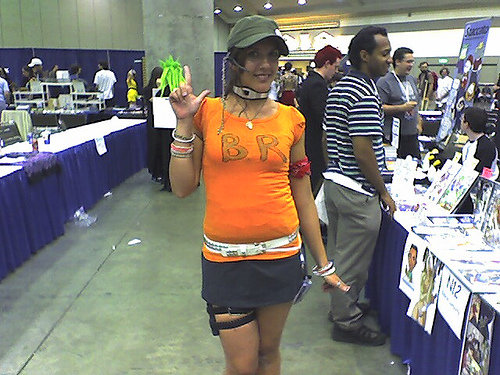
At Otakon I talked on several panels, including one on “trends in otaku culture in Japan,” where I got a lot of questions about the word otaku itself. Although it’s come to equal “anime fan” or “anime geek” here in the West and serve as a badge of honor for those who revere Japanese popular culture, the word otaku is originally a polite word meaning “you” or “your family.” It’s kind of a “housewife word,” with the most common usage being between housewives in the neighborhood. Urayamashii ne, otaku no ko wa mainichi benkyo, one might say to another, meaning “I really envy you, your son studies everyday.” (Japanese are into praising each other’s kids while putting their own kids down in front of others, it’s a humility thing.) The word became used to refer to people who obsessed over anime in the 1990s when Gainax release their classic Otaku no Video, which documents one character’s slide from “normalcy” into otakuhood. More than any other animation company, Gainax has helped create a self-aware “otaku” generation (and we thank them for it).
J-List has a great line of wacky Japanese T-shirts, which present funny or aesthetically beautiful kanji shirt designs for you. We’ve got dozens of shirts for guys and girls, as well as great hoodies for the cooler months, in stock for you, all printed here in San Diego by our dedicated staff. We’re always closing out designs to make room for others, so if you like the look of one of our shirts, you might want to get before the design is cycled out in favor of new ideas. We’ve recently reduced the price of some of our close-out shirts, including a cool shirt that teaches you some Japanese words and culture. Why not browse our great T-shirts today?