The 150 Year Anniversary of the End of the Edo Period
One enjoyable aspect of living in Japan is enjoying the country’s long history. Perhaps this comes from me being from San Diego, one of the youngest cities in the U.S. In San Diego, pretty much the oldest thing around is the 130-year-old Hotel Del Coronado, but I really enjoy being in a country where I can explore temples that are five times the age of my country. You don’t even need to go to Kyoto to see cool old stuff. Just last weekend I climbed a mountain to find a cool old stone Buddha.
I happened to see that today — May 3rd — exactly marks the 150 year anniversary of the end of the Edo Period (March 24, 1603-May 3, 1868), when the 15th Tokugawa Shogun surrendered rule of the country in favor of an ostensibly modern government centered around the Japanese Emperor, who had long been a powerless figurehead. This was the Meiji Restoration, an amazing period of history because Japan basically went from a backward feudal country to a modern country in a couple of decades.
I know Japan’s long history can be confusing when you’re not familiar with it. I thought I’d do a short post giving an overview of the various historical eras.
Jomon Period (14,000-300 BC). Japan was occupied from 14,000 years ago by people who left behind clay pots with unique jomon markings on them, which is where the Jomon period gets its name. By chance, the oldest known human habitation in Japan is a place called Iwajuku, which is located about 20 km from J-List.
Yayoi Period (300 BC-300 AD). The first beginnings of culture in Japan as rice cultivation is begun.
Kofun Period (300-538). The “mound building era” when 161,000 burial mounds were constructed throughout the country, as culture and political power grew. There are several burial mounds located around J-List. Since no one is allowed to build on them, it’s common to establish parks around them, so children can play and slide down 2000-year-old tombs, which I did with my kids many times.
Asuka-Nara-Heian Periods (538-1185). Japan begins to truly take the shape we identify today, building a great capital in Nara and later in Kyoto, and concentrating on poetry, literature, and art. The Tale of Genji, Japan’s first “harem anime” about a handsome son of the Emperor who has many loves, is published around 1021. A great war between the Minamoto and the Taira clans is fought from 1180-1185. The red-and-white Japanese flag actually refers to this conflict, based on the standards of these two families.
Kamakura and Azuchi–Momoyama Periods (1185-1333). The warriors who fought in the previous war realized they held the actual political power, and the Kamakura bakufu (military government) was formed. Many schools of Buddhism that are active today have their roots in this era. Japan also had to organize itself against Mongol invaders from the Korean peninsula.
Muromachi Period (1336-1573). A period of ongoing struggles between different would-be rulers of Japan, which is known as the Sengoku Jidai or “Age of Warring States.” The first foreigners (the Portuguese) show up, bringing Christianity and guns.
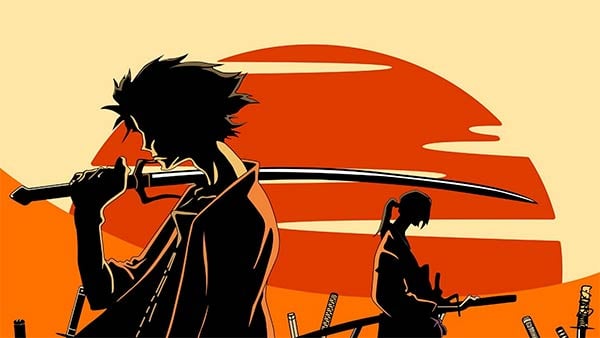
Azuchi–Momoyama Period (1573-1603). Oda Nobunaga, the first of Japan’s three “great unifiers” accumulates enough power that he becomes the de facto shogun (absolute military ruler) of Japan. Nobunaga was a great lover of unique things from foreign lands, and one of his samurai retainers was an African named Yasuke who was brought to Japan with Jesuits, meaning that Afro Samurai is based on a true story. Nobunaga was betrayed by an underling and died by seppuku in Honnō-ji, in Kyoto in an event that’s as famous to Japanese as the Alamo is to Americans. Nobunaga’s general (and the second unifier), Hideyoshi, avenges his lord then becomes the de facto shogun himself, which is interesting because he started out as a peasant. He dies, and the third unifier, Tokugawa Ieyasu, defeats the other clans to finally become Shogun.
Edo Period (1603-1868). The longest and most peaceful era in Japanese history, as the Tokugawa clan remade the country into a new feudal entity, with every local lord dependant on the shogun for his land holdings. Many limitations are put on society in general, organizing everyone into four classes: warriors, farmers, artisans, and merchants, in that order. The country was closed off from the outside, and only the Dutch were allowed to trade in Japanese ports. Virtually everything that’s famous about Japan’s culture, from ninjas to kabuki to geisha, developed in the cultural soup that was the Edo Period.
Meiji Period (1868-1912). The Edo Period came to an end when the United States forced Japan to start trading. The strong Satsuma and Choshu domains hated foreigners and supported “restoring” the Meiji Emperor to power so they could keep foreign influence out. The minute they succeeded in nearly bloodless coup, they realized they needed foreign technology, and started rapidly modernizing, importing technology from the West at a breakneck pace.
Taisho Period (1912-1926). A short period that saw an increase in Japan’s stature as a nation, and a terrible earthquake that destroyed Tokyo.
Showa Period (1926-1989). The long reign of Emperor Hirohito saw Japan become a belligerent power and attempt to take on the British Empire and later the United States. Afterwards, the country became one of the most peaceful in the world, making old-timey candies and toilet seats that wash your butt. Also, manga, anime and hentai.
I hope you’ve enjoyed this short overview of Japanese history. I hope you can visit Japan and experience some of the country for yourself!