August in Japan is always a heavy month, and not just because of the heat and humidity. It’s the season when the country reflects on all the important anniversaries related to the end of WWII. It’s also when they remember the crash of JAL Flight 123, which happened 40 years ago today. Among the 520 lives lost was Kyu Sakamoto, singer of the famous Sukiyaki Song. In this post, we’ll revisit that sad day and explore Japan’s unique relationship with death.
J-List has started a new sale, this time on all hentai manga we have in stock, as well as limited anime Blu-ray titles, and anime games for your Nintendo Switch. Get 18% off all these products until March 23. Start browsing here!
August is a Solemn Time in Japan
August is always a solemn month here in Japan. The TV is full of documentaries about the atomic bombing of Hiroshima and Nagasaki, and the end of WWII on August 15. Then there are the Obon holidays (Aug. 13-16), when everyone visits their family graves to let their dead ancestors know they haven’t been forgotten. Finally, there’s the anniversary of JAL Flight 123, a terrible crash that happened 40 years ago today. Among the 520 lives lost in the disaster was Kyu Sakamoto, famous worldwide as the singer of the Sukiyaki Song, aka Ue o Muite Aruko.
Before I started J-List, I had a lot of excess energy. I would study for the Japanese Language Proficiency Test, take it in December, then start studying again in January in case I failed and would need to retake it next year.
Another thing I enjoyed doing was cycling around Gunma Prefecture, exploring interesting locations. One day, I told Mrs. Pre-J-List I was going to visit Ueno-mura in Southern Gunma and explore some caverns I’d read about, camping there for one or two nights. She shuddered at hearing this name. When I asked about her reaction, she told me, “That was the site of that terrible airplane crash, JAL Flight 123, back in 1985.

The Tragedy of JAL Flight 123 and Kyu Sakamoto
On August 12, 1985, a Boeing 747SR-46 took off from Haneda Airport headed for Osaka. But twelve minutes into the flight, a catastrophic failure of the rear pressure bulkhead tore off the tail and disabled the plane’s hydraulics. For a horrifying 32 minutes, the pilots tried to control the plane, but they were unsuccessful. The plane crashed into the side of a mountain in Ueno-mura, Gunma Prefecture.
The crash was quickly located by an American C-130 that happened to be flying in the area, and the US military offered assistance. Unfortunately, Japan’s Self-Defense Forces declined this offer, leading to an additional 12-hour delay. In the end, only four of the 524 passengers and crew would survive the crash, making it the deadliest single-jet air accident in history to date. In addition to passengers from the US, Italy, and Hong Kong, singer Kyu Sakamoto lost his life in the crash.
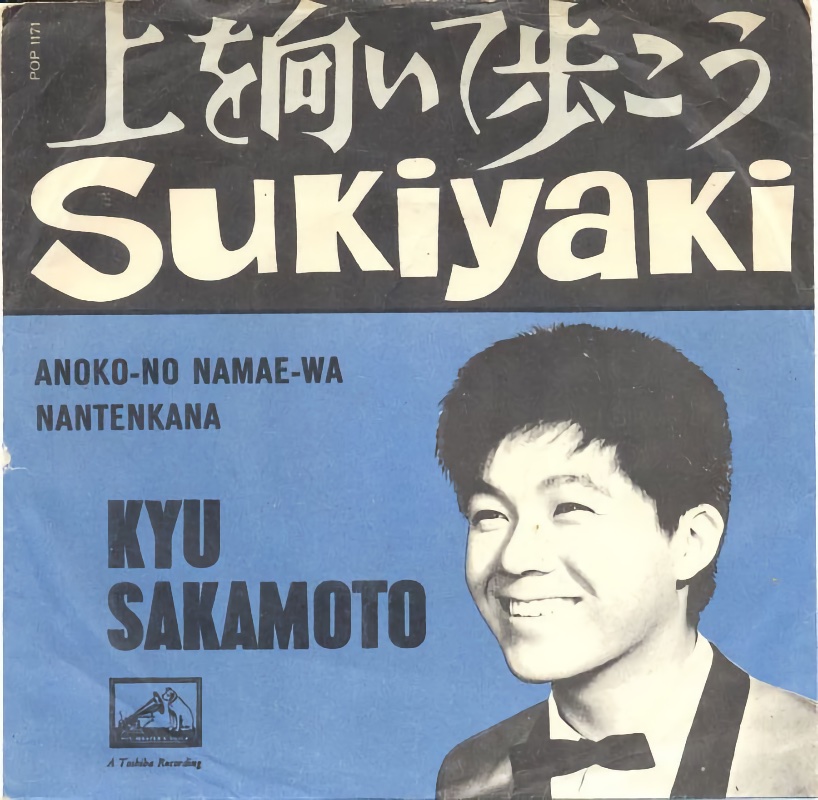
The History of the Sukiyaki Song
Kyu Sakamoto was born in 1941 and played in a high school band, with a dream of becoming a famous singer one day. He became a staple on variety shows in the 1950s. In 1961, he released Ue o Mite Arukō, which became a smash hit all over Japan.
A British record executive happened to hear the song while visiting Japan, and decided to release an instrumental version. Because the Japanese title would be impossible for Westerners to learn, he changed the name to Sukiyaki Song, because that was a popular dish from Japan that everyone knew. In 1963, an American DJ named Richard Osborn in Washington State decided to play the Japanese original, which he’d gotten from a Japanese exchange student. The song exploded in popularity despite being in Japanese, spending three weeks at the #1 position.
Although the song sounds upbeat, it’s actually quite a sad story about a man raising his face to the sky while walking to keep his tears from spilling. Why is he sad? It’s not specified in the song whether the emotions are coming from a breakup or some other kind of loss, so it can apply to any of us at different points in our lives. It’s a song about resilience and finding the strength to keep going. Because (to quote another Kyu Sakamoto song), Ashita ga Aru — there will always be a tomorrow, another day dawning, and things might get better.
The best way to understand what Japan was like when the Sukiyaki Song was released back in 1961 is this scene from Up On Poppy Hill, the outstanding film by Hayao Miyazaki and Studio Ghibli. It really shows us what things were like back in Showa-era Japan. (We have the film on Blu-ray with full subtitles and dubbed track here, if you’re curious.)
Is Japan All About Death?
There can be quite a difference between visiting Japan for a week or so as a tourist and actually living here for a year or more. This is because being here for a longer period of time causes you to think more deeply about Japan and its culture. One impression I’ve heard from foreigners living here is that “everything in Japan is about death.” Is this really true?
It can certainly seem that Japan, with its Buddhist customs intertwining with various aspects of daily Japanese life, does have a connection to death. Here are a few examples:
- When eating, it’s very rude to stand chopsticks up in your rice. This is called tachibashi, and it’s reserved for a ceremonial funerary offering.
- Similarly, passing food to another person with chopsticks is taboo. After a person is cremated, their loved ones will pair up and place the bones into an urn using special long chopsticks.
- A bed must never be situated so that your head is pointed north while you sleep. This is called kita-makura or “north-pillow,” and is reserved for — you guessed it — the dead during funerals.
- The Japanese can be very superstitious when it comes to numbers, and like to avoid the numbers 4 (shi) and 9 (ku) because they phonetically relate to death and suffering. The granddaddy of all Japanese superstitions is yakudoshi, an “unlucky year” that crops up every so often. For men, 42 is the most unlucky age; for women, it’s 33. Both numbers are based on accidental phonetic connections to death.
In Buddhism, you never mark a person’s birthday once they’ve died. Instead, you remember them on their 命日 meinichi, or the anniversary of their death. Today, August 12th, is the meinichi of Kyu Sakamoto and the other 519 people who lost their lives on the worst air disaster in Japanese history.
Thanks for reading this blog post about the 40th anniversary of the tragic JAL Flight 123, including Sukiyaki Song singer Kyu Sakamoto.
Let’s Chat
You made it to the end of this post! Thank you! As a token of our appreciation, enjoy an extra 5% off your next order when you use the code BLOG at checkout. Also, don’t forget to follow J-List on all our platforms!
- Twitter / X, where Peter posts anime booba for you
- Bluesky, where we post several times a day
- Facebook, where we used to share memes and discuss anime
- Discord, if you want to chat with other J-List customers of culture

J-List has started a new sale, this time on all hentai manga we have in stock, as well as limited anime Blu-ray titles, and anime games for your Nintendo Switch. Get 18% off all these products until March 23. Start browsing here!