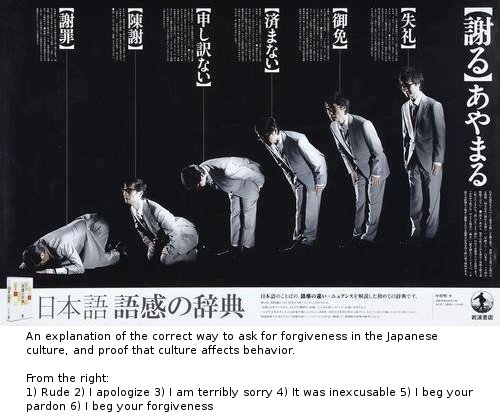
It’s well known that bowing is something done in Japan as a greeting or to express respect or apology. There are many kinds of bows, from the casual ojigi you make to a coworker to a deeper bow of thanks you’d do when accepting your salary envelope from your boss on payday to the always-fun “bowing to someone while talking to them on the phone,” which I catch myself doing. When I went to work for a large English school I had my first experience with chorei (lit. “morning bow”) which is a brief formal meeting where the employees stand in a circle and basically promises to gambaru, or do their best and work hard, followed by a deep bow. Bowing is done in Japanese public schools, too: when the teacher enters the classroom the students stand as one and bow, then take their seats again. I once had a class of students at a business school I taught at do this to me, which really freaked me out. I told them that since there were to learn English from me, I’d be happy if they treated me like an American teacher.